
Instructions for Conducting Examinations 2024 ー Overall Overview
These guidelines detail standardized procedures for administering examinations, ensuring fairness, security, and consistency throughout the 2024 assessment period.
Welcome to the 2024 Examination Guidelines, a comprehensive resource designed to support all personnel involved in the administration of assessments this year. These guidelines represent a commitment to maintaining the highest standards of academic integrity and providing a fair and equitable testing environment for all candidates.
This document outlines the essential procedures, from pre-examination preparations to post-examination protocols, ensuring a smooth and secure examination process. It is crucial that all invigilators, examination coordinators, and administrative staff thoroughly familiarize themselves with the contents herein.
Adherence to these guidelines is not merely recommended; it is mandatory. Any deviations from established procedures must be documented and reported to the Examination Board. These guidelines are regularly reviewed and updated to reflect best practices and address emerging challenges in examination administration. Your diligence in following these instructions is greatly appreciated.
Key Changes from Previous Years (2023)
Several key modifications have been implemented for the 2024 examination cycle, building upon feedback from previous years and incorporating advancements in assessment security. Most notably, the process for handling suspected academic misconduct has been revised, with a clearer emphasis on initial reporting and evidence preservation.

Furthermore, the guidelines regarding the use of personal devices during examinations have been strengthened. Candidates are now prohibited from having any electronic devices, including smartwatches, in their possession during the examination, even if switched off.
A new protocol for administering special accommodations has also been introduced, requiring pre-approval documentation to be submitted to the Examination Office at least one week prior to the examination date; Detailed training materials covering these changes are available on the staff portal. Please review them carefully to ensure full compliance.

Pre-Examination Procedures
Thorough preparation before the exam is crucial; this includes scheduling, staff training, hall readiness, and secure paper management for a smooth process.
Examination Schedule and Timetable Distribution
The finalized examination schedule, detailing dates, times, and subject codes for each session, must be approved by the Examinations Board before distribution. Distribution should occur at least two weeks prior to the first examination date, allowing ample time for candidates to prepare and make necessary arrangements.
Multiple channels should be utilized for dissemination: official university/school website posting, email notifications to registered students, and physical posting on designated notice boards. Timetables must be clear, concise, and easily accessible. Any subsequent amendments or changes to the schedule require immediate and widespread communication, following the same distribution methods.

Departmental heads are responsible for ensuring all faculty and relevant staff are fully aware of the schedule. A master copy of the schedule, along with a record of all distribution methods and dates, must be maintained by the Examinations Office for audit purposes. Confirmation of receipt from departments is also required.
Invigilation Staff Training and Briefing
Comprehensive training for all invigilators is mandatory prior to the commencement of examinations. This training will cover examination regulations, invigilator duties, proper handling of sensitive materials, and procedures for dealing with candidate irregularities. A detailed briefing session will be conducted by the Examinations Office, outlining specific instructions for each examination session.
Training will emphasize maintaining a secure and fair examination environment, ensuring candidates understand the rules, and responding appropriately to any disruptions. Role-playing scenarios will be used to practice handling common issues like suspected cheating or requests for clarification.
All invigilators must acknowledge their understanding of these guidelines by signing a confidentiality agreement. A training manual will be provided for reference, and a designated contact person will be available to address any questions or concerns during the examination period.

Preparation of Examination Halls
Examination halls must be prepared meticulously before each examination session to ensure a conducive and secure testing environment. This includes arranging desks appropriately, maintaining adequate spacing between candidates, and ensuring sufficient lighting and ventilation. All unauthorized materials, such as notes, textbooks, and mobile phones, must be removed from the hall.
Clear signage indicating examination rules and emergency procedures should be prominently displayed. Clocks must be visible to all candidates, and any distracting posters or decorations should be removed. A designated area for personal belongings should be established, separate from the seating area.
Invigilators are responsible for verifying that all necessary materials, including examination papers and stationery, are present and accounted for before candidates enter the hall. Any discrepancies must be reported immediately to the Examinations Office.

Secure Storage and Handling of Examination Papers
Maintaining the integrity of examination papers is paramount. All papers must be stored in a locked, secure room with restricted access, only available to authorized personnel. A detailed log must record all instances of paper access, including date, time, and the name of the individual removing or returning the papers.
Prior to the examination, papers should be counted and verified against the candidate list. During transportation within the building, papers must be securely packaged and accompanied by at least two authorized personnel.
Under no circumstances should examination papers be left unattended or discussed with anyone not authorized to view them. Any compromised or damaged papers must be immediately reported to the Examinations Office for replacement. Strict adherence to these protocols is crucial to prevent leaks and maintain fairness.

During the Examination
Invigilators must maintain a quiet, controlled environment, closely monitor candidates, and ensure adherence to all examination regulations throughout the session.
Invigilator Responsibilities and Duties
Invigilators are central to maintaining examination integrity. Before distribution, verify the correct paper is for the session. Distribute papers uniformly and announce start/end times clearly.
Throughout the examination, actively supervise candidates, preventing any unauthorized materials or communication. Address candidate queries calmly and accurately, avoiding any guidance on answers.
Be vigilant for any signs of academic misconduct, such as cheating or collusion, and document any irregularities immediately. Ensure candidates adhere to seating arrangements and permitted items.
Collect answer sheets promptly at the end, verifying each candidate has submitted their work. Maintain a secure environment and report any issues to the examination coordinator without delay.
Remain attentive and professional throughout the entire process, upholding the standards of academic honesty and fairness.
Candidate Identification and Seating Arrangements
Prior to the examination, clearly display seating plans ensuring sufficient space between candidates. Candidates must present valid photo identification (student ID, passport) for verification by the invigilator.
Invigilators will meticulously check identification against the examination register, confirming each candidate’s eligibility. Any discrepancies must be reported immediately to the examination coordinator.
Candidates should be directed to their assigned seats, and any unauthorized changes are prohibited without explicit permission. Seating arrangements should minimize potential for communication or collusion;
Ensure all candidates understand the seating plan and identification requirements before the examination commences. A quiet and orderly seating process is crucial for maintaining a fair testing environment.
Maintain a record of any identification issues or seating adjustments made during the examination process for audit purposes.
Handling of Examination Irregularities (Cheating, Disruptions)
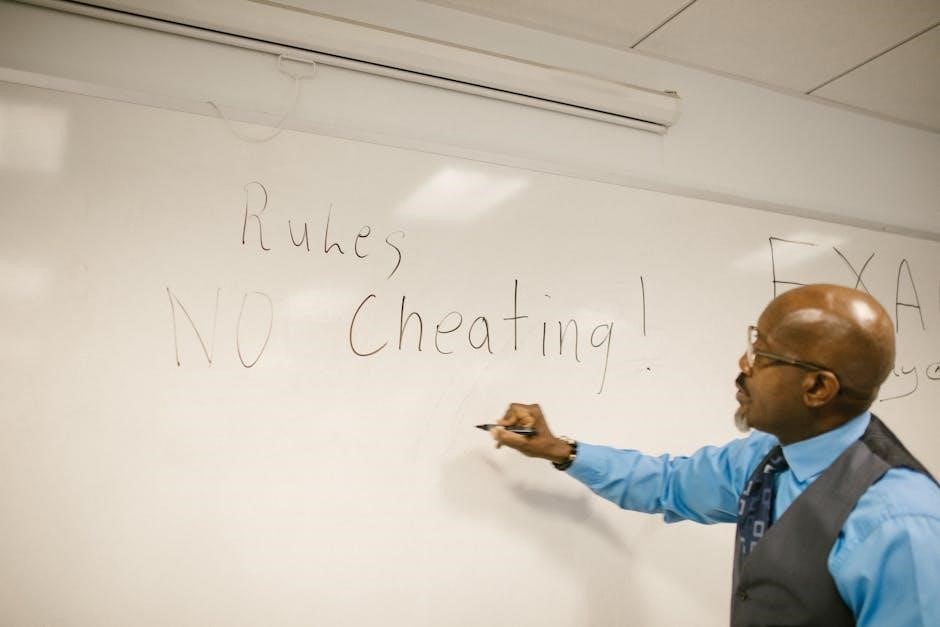
Invigilators must remain vigilant for any signs of academic dishonesty, including unauthorized materials, communication, or copying. Suspected cheating requires immediate, discreet intervention.
If cheating is observed, calmly request the candidate to cease the activity and secure any prohibited items. Do not engage in lengthy arguments or accusations.
Document the incident thoroughly, including the candidate’s name, seat number, a detailed description of the irregularity, and any evidence collected.
Disruptive behavior, such as talking or using electronic devices, should be addressed promptly and firmly. A warning should be issued initially, followed by removal if the behavior persists.
All irregularities must be reported to the examination coordinator immediately after the examination, along with the completed irregularity report form. Maintain confidentiality throughout the process.
Administration of Special Accommodations
Candidates requiring special accommodations, such as extra time or assistive technology, will be pre-identified on the seating plan. Invigilators must familiarize themselves with these arrangements before the examination begins.
Ensure the candidate receives the correct adjusted time limit, clearly displayed. For assistive technology, verify functionality and provide a suitable workspace.
Separate seating may be required for some accommodations to minimize distractions. Maintain the candidate’s privacy and dignity throughout the process.
Do not inquire about the nature of the candidate’s disability. Accommodations are provided based on pre-approved documentation.
Any issues or concerns regarding accommodations should be immediately reported to the examination coordinator. Accurate record-keeping of implemented accommodations is essential for reporting purposes.
Post-Examination Procedures
Following the examination, meticulous procedures for script handling, attendance verification, and reporting any irregularities are crucial for accurate results processing.
Collection and Secure Packaging of Answer Scripts
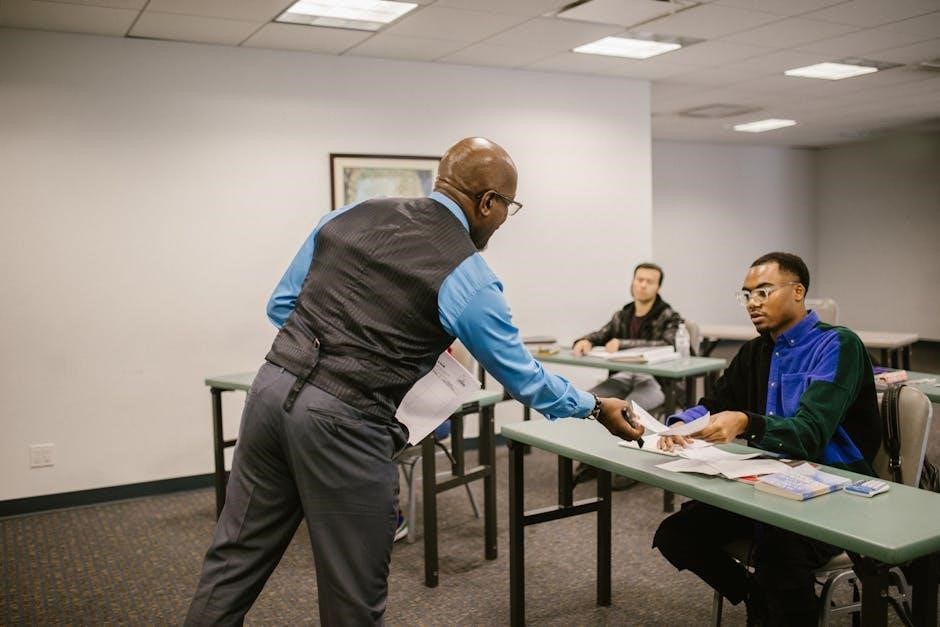
Immediately after the examination concludes, invigilators must systematically collect all answer scripts from candidates. Each script should be checked against the corresponding seating arrangement to ensure none are missing.
Scripts must then be organized in a pre-defined order – typically by candidate number – and securely bundled with the appropriate cover sheet. These cover sheets must be accurately completed with all required details, including the examination name, date, and any special accommodations granted.
Bundles should be placed into tamper-evident, sealed envelopes or bags, clearly labeled with the examination details and the invigilator’s signature. A detailed record of the number of scripts collected and packaged must be maintained.
These packaged scripts are then to be transferred to the designated secure holding area, following the established chain of custody protocol, ensuring complete accountability at all times.
Submission of Attendance Records and Irregularity Reports
Following the completion of each examination session, invigilators are required to submit accurate and complete attendance records. These records must detail all candidates present, absent, or those who experienced any issues during the examination.
Concurrently, any irregularity reports – documenting instances of suspected cheating, disruptive behavior, or technical difficulties – must be submitted using the designated official form. These reports should be detailed, objective, and include the names of any witnesses.
Both attendance records and irregularity reports must be submitted to the examination coordinator within the specified timeframe, typically within 24 hours of the examination’s conclusion.
Ensure all submissions are legible and properly signed. Late or incomplete submissions may compromise the integrity of the examination process and delay results processing.
Data Entry and Initial Script Verification
Upon receipt of answer scripts, designated personnel will undertake data entry of candidate information and marks into the centralized examination database. Accuracy during this phase is paramount; double-checking all entries is mandatory to minimize errors.

Simultaneously, an initial verification of answer scripts will be conducted to ensure all scripts are present, correctly identified with candidate numbers, and free from any obvious anomalies – such as missing pages or illegible handwriting.
Any discrepancies identified during data entry or script verification must be immediately reported to the examination coordinator for resolution.
Strict adherence to data protection protocols is essential throughout this process. Access to candidate data and answer scripts should be limited to authorized personnel only.
General Administrative Guidelines
All personnel must adhere to established communication channels, maintain strict confidentiality, and promptly address any issues with designated support contacts.
Communication Protocols and Emergency Procedures
Effective communication is paramount during examinations. A designated communication chain must be established, outlining reporting procedures for any incidents. All invigilators should have readily available contact details for senior invigilators, exam coordinators, and emergency services.
In case of emergencies – fire, medical incidents, or security breaches – invigilators must prioritize candidate safety. Evacuation procedures should be clearly understood and practiced beforehand. A designated assembly point must be identified.
Communication regarding exam-related issues (e.g., missing materials, candidate queries) should follow the prescribed protocol, avoiding direct contact with external parties. Use of personal mobile phones for communication during the exam is strictly prohibited. Detailed incident reports, including time, nature of the event, and actions taken, must be submitted promptly after the examination.
Confidentiality and Data Protection
Maintaining the confidentiality of examination materials and candidate data is of utmost importance. All personnel involved must adhere to strict data protection protocols, complying with relevant privacy regulations. Examination papers must be stored securely, accessible only to authorized individuals.
Candidate answer scripts should be handled with care, ensuring anonymity and preventing unauthorized access. Discussions regarding exam content or candidate performance are strictly prohibited outside of designated assessment review meetings.
Digital data, including attendance records and irregularity reports, must be stored on secure servers with appropriate access controls. Any breach of confidentiality or data protection protocols must be reported immediately to the exam coordinator and relevant data protection officer. Strict adherence to these guidelines is essential for maintaining the integrity of the examination process.
Contact Information for Support and Clarification
For any queries, concerns, or support related to these examination instructions, please do not hesitate to contact the designated Examination Support Team. Our primary point of contact is Ms. Eleanor Vance, the Examination Coordinator, reachable at eleanor.vance@university.edu or by phone at +1-555-123-4567.
Technical support regarding the online examination platform is available from the IT Helpdesk at it.support@university.edu or +1-555-987-6543. For urgent issues during an examination, invigilators should immediately contact the designated Exam Supervisor present in the hall.
A comprehensive FAQ document addressing common questions is available on the university’s examination portal. We encourage all staff to review this resource. Prompt and clear communication is vital for a smooth examination process.